
'It is critical that the Covid curve does not have a fat tail and the chain is broken quickly.'

The country's dash to a $3-trillion market cap is more a case of teamwork, than a few members doing most of the heavy lifting. Sample this: The share of top 100 companies to India's total market cap (BSE-listed companies' m-cap) is 67.3 per cent currently, less than what it has been when the nation hit previous milestones, such as $1 trillion, $1.5 trillion in 2007 or $2.5 trillion more recently in December 2020. In 2007, when India's m-cap topped the $1-trillion mark for the first time, the top 100 companies accounted for three-fourths of the total m-cap; at $1.5 trillion, the share was almost 80 per cent.

Thirteen companies have joined the Rs 1-trillion-plus market capitalisation club this year, so far. This even as the benchmark Sensex has gained less than 3 per cent on a year-to-date basis, underscoring the bullish undercurrent in the broader market. The trend shows a harsh second wave of Covid-19, subsequent lockdowns, and hit to the economic activity has made little dent into India Inc or shareholders' wealth. At the start of the year, there were 29 companies with a market value of more than Rs 1 trillion.

Top officials said asking employees other than the fund management team to mandatorily invest a fifth of their salary goes against the principle of natural justice.

Industry players estimate the average payouts to be in the range of 50-75 per cent of the bankers' annual salaries. For the top performers, the bonuses could be 100-125 per cent.

In 2020-21, Indian firms offered to buy back shares worth Rs 39,295 crore, or 97% more than Rs 19,972 cr proposed in the previous financial year.

Operational and compliance challenges foreseen for fund houses in deducting tax at source, resulting in possible TDS mismatches and disputes with investors.

Covid-19, US yields, dollar to weigh on equity flows in the near term.

The Nifty Bank index has come off 15 per cent from its peak in February, underperforming the benchmark Nifty which is down 6%.
The 30-share bluechip index is rebalanced on a semi-annual basis with next rejig slated for June 18.

Debt funds typically held 0-5 per cent of their portfolio in cash and cash equivalents before this Sebi diktat.

While the stocks met various other inclusion parameters, there were fears they may still get disqualified given the sharp run up in their stock prices.

The SME segment has been grappling with lack of liquidity and lacklustre institutional participation.

'Start-ups that generate a majority of their income in India are likely to opt for an Indian listing.'

The listing day gain-to-loss ratio for FY21 was 71 per cent, the highest since FY17, when it was 85 per cent.

The finance ministry said the sharp inflows last fiscal were due to the government's policy initiatives and economic recovery.
'It won't help being complacent about the momentum and valuations of equities that currently exist.'
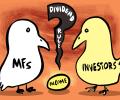
Experts believe the new norms may be an indirect way for Sebi to apply the brakes on dividend option plans in MFs.

Jhunjhunwala, one of India's well-known individual investors, was speaking at the India Economic Conclave organised by the Times Network. He said he won't rule out 5-10 times gains in state-owned banks over the next five years. Shares of PSBs have been on a tear this year. The Nifty PSB index is up 20 per cent so far this year.

Mutual funds (MFs) are set to be net sellers of Indian equities for the first time in the past seven financial years, having sold stocks worth about Rs 1.27 trillion so far in 2020-21 (FY21), making it the highest net sales on record in a financial year. MFs had been net buyers in the previous six financial years, including purchases of over Rs 1.41 trillion in FY18, Rs 88,152 crore in FY19, and Rs 91,814 crore in FY20. The last time they offloaded Indian equities was in FY14, when they net sold stocks worth Rs 21,159 crore. In contrast, foreign portfolio investors (FPIs) have ramped up buying in FY21, purchasing more than Rs 2.6 trillion worth of shares.
 © 2026 Rediff.com - Investor Information - Advertise with us - Disclaimer - Privacy Policy - Sitemap - Feedback - About us - Terms of use - Grievances